
AL-KĀTIB (The Scribe)
Al-Kātib is the title under which the artist executes Ṣaḥīfat al-Ṣabr (the Scroll of Patience). He acts as a tarāki (an accumulator [of marks]) not as an autonomous muṣawwir (image-maker/form-giver) of self-expressive creation, but as a custodian bound to procedural law–maintaining absolute fidelity to an al-Tarākum (Accumulationist) protocol while releasing individual passages.
ARTIST’S BIOGRAPHY
Abdushakur (b. 1405 AH / 1985 CE) is al-Kātib (the Scribe) of a lifelong manuscript titled Ṣaḥīfat al-Ṣabr (the Scroll of Patience). Based in New York City, his practice transforms patience–understood as an obligation of gratitude (shukr)–into an unceasing ink-field of al-Tarākumiyyah (Accumulationism).
His path began with a decisive rupture after his Shahādah (1432 AH / 2011 CE). Out of an initial taqwā—a sudden and profound fear of Allah’s punishment—he abandoned all figural representation and the prior career that depended on it. Later study of the classical boundary of Mā Lā Nafsa Lahū (“that which possesses no soul”), contained in the narration “If you must do it…”, gave disciplined form to a residual compulsion to continue making marks. As al-Kātib, he channels this into meticulous ink fields: quiet acts of shukr (gratitude) that record time through continuous, non-imitative labor.
He transcribes The Scroll of Patience through nusuk al-qalam (the procedure of the pen). Rejecting digital tools or compositional planning, each work remains a direct, topographical record of ṣabr (patience) and dhikr (remembrance). The process is governed by al-itqān (precision) and indibāṭ (structural discipline). Individual pieces from the ongoing scroll are released as standalone passage records.
Works from this corpus are held in private collections across the United States, Egypt, and Europe.
FOUNDATIONAL AXIOMS
The Epistemic Rupture
The practice originated in the prophetic warnings against figurative representation (taṣwīr). The immediate refusal came from the hadith:
إن أصحاب هذه الصور الذين يصنعونها يعذبون يوم القيامة يقال لهم أحيوا ما خلقتم
The makers of these images will be punished on the Day of Resurrection, and it will be said to them: 'Breathe life into that which you have created.' — Ṣaḥīḥ al-Bukhārī, 7558
Subsequent study confirmed the legal allowance narrated by Ibn 'Abbās:
إِن أبيت إلا أن تصنع، فعليك بهذا الشجر، كل شىء ليس فيه روح
If you must do it, then make images of trees and lifeless things (Mā Lā Nafsa Lahū). — Ṣaḥīḥ Muslim, 5272
This boundary transformed a visceral necessity into a sanctioned, disciplined path.
The Lineage of the Pen
The work stands in the lineage of the Pen (al-Qalam), the first of creation:
إِن أول ما خلق اللَّه القلم فقال اكتب فقال ما أكتب قال اكتب القدر ما كان وما هو كائن إلى الأبد
Indeed, the very first thing Allah created was the Pen. He said: 'Write.' [The Pen] said: 'What should I write?' He said: 'Write the decree—what has been and what will be forever.' — Jami' al-Tirmidhī, 3319
The Aesthetics of Precision (Al-Itqān)
The methodology honors the Divine love of beauty and mastery:
إن الله جميل يحب الجمال
Allah is Beautiful, He loves beauty. — Riyāḍ al-Ṣāliḥīn, 611 (Muslim)
Rather than inventing forms through ego or mimesis, the labor manifests order, precision, and structural truth as gratitude for Divine Mercy. It rejects transient imitation in favor of disciplined submission through an infinite, lifeless form.
The Operational Ethos
Every mark follows the prophetic guidance:
الأَناة من اللَّه والعجلة من الشيطان
Deliberation (and patience) are from Allah, and haste is from Satan. — Jami' al-Tirmidhī, 2012
The hand moves in alignment with the heart. Speed is secondary to stillness. Each stroke becomes an exercise in indibāṭ (structural discipline) and dhikr.
The Durational Mandate
The infinite nature of the work echoes the Qur'anic witness to the inexhaustibility of the Divine Word:
قُل لَّوْ كَانَ الْبَحْرُ مِدَادًا لِّكَلِمَاتِ رَبِّي لَنَفِدَ الْبَحْرُ قَبْلَ أَن تَنفَدَ كَلِمَاتُ رَبِّي وَلَوْ جِئْنَا بِمِثْلِهِ مَدَدًا
Say: ‘If the sea were ink for (writing) the Words of my Lord, surely, the sea would be exhausted before the Words of my Lord would be finished..’ — Qur’an 18:109
(and Qur’an 31:27)
وَلَوْ أَنَّمَا فِي الْأَرْضِ مِن شَجَرَةٍ أَقْلَامٌ وَالْبَحْرُ يَمُدُّهُ مِن بَعْدِهِ سَبْعَةُ أَبْحُرٍ مَّا نَفِدَتْ كَلِمَاتُ اللَّهِ ۗ إِنَّ اللَّهَ عَزِيزٌ حَكِيمٌ
METHOD
System and Framework
The practice follows a strict al-Tarākum (Accumulationist), non-representational protocol. Every work belongs to the single cumulative corpus. Inclusion requires complete methodological fidelity.
Execution Protocol
All works are made exclusively by hand with a 0.30 mm Staedtler Marsmatic 700 technical pen and Dr. Ph. Martin’s Black Star India Ink on archival Bristol paper. There is no preparatory sketching, no compositional planning, no mechanical reproduction, and no digital intervention. Mark-making is incremental and continuous; duration itself is a core material.
Formal Constraints
The work is strictly non-figurative and non-imitative. Structure emerges through repetition, density, and controlled variation within a closed procedural logic. Uninked areas serve as structural pauses.
Standardized Formats
فَصْل (Faṣl / Section): 27.9 × 35.5 cm
مقتطف (Muqtaṭaf / Excerpt): 50 × 70 cm
ورقة كبرى (Waraqah Kubrā / Monument): Large-scale sheet
سَفِينَة الصَّبْر (Safīnat al-Ṣabr / The Vessel of Patience): 13.9 × 20.3 cm
Archival and Material Ethic
All works are rigorously documented. Al-itqān (precision), indibāṭ (structural discipline), and ṣabr (patience) are non-negotiable. Evaluation rests on consistency of line, continuity of process, and full completion of the surface.
Note on the Early Corpus
The practice of non-representational accumulation under the original constraint began in 2011. The majority of the physical sheets and objects produced between 2011 and the formalization of Ṣaḥīfat al-Ṣabr are no longer in the artist’s possession. The sole surviving object from the initial 2011–2012 phase is the original Kitāb al-Ṣabr, which sustained water damage after seven pages.
The current corpus, beginning with the standardized and serialized works, is the portion of the practice that remains fully documented, controlled, and authenticable.
Current Production Parameters
The present phase of the corpus is limited to approximately fifty sheets in the 50 × 70 cm format and approximately fifty sheets in the 27.9 × 35.5 cm format. These individual sheets are the only works available for acquisition (post-archive or reserved).
Upon completion of this phase, primary labor will shift to the continuous handscroll (Ṣaḥīfat al-Ṣabr), which will remain outside the market and will not be offered for sale. The individual sheets serve to reconstitute a documented body of work after the loss of the majority of the earlier physical output.
WORK NOTES
Pre-1447 AH / 2026 CE pieces remain outside the current registry. This platform documents only standardized works executed under the active serialization protocol, completed corner-to-corner.
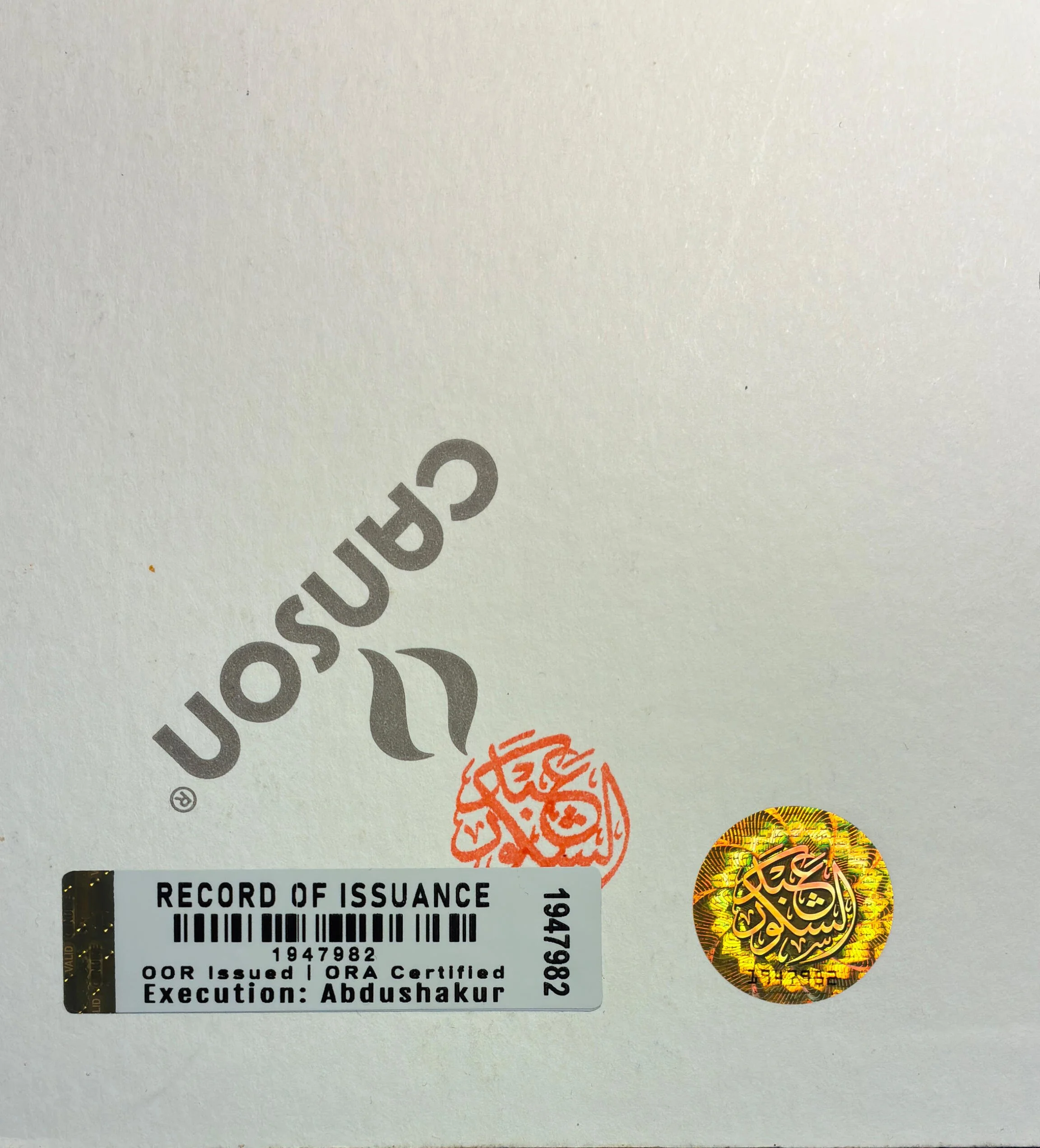
SERIAL INDEX: 1947982
CLASSIFICATION: مقتطف (Excerpt) – Legacy Scale [discont.]
DIMENSIONS: 40.6 × 50.8 cm
SUPPORT: Canson Illustration Board
MEDIUM: Technical Pen & Ink (.30mm)
AUTHENTICITY: OOR Issued | ORA Certified
EXECUTION: Abdushakur